How Old Is the Internet Today? The Fascinating 57-Year History Explained
If you have ever wondered how old is the internet today, the answer depends on which milestone you use as its “birthday.” The internet’s roots go back decades before social media, smartphones, Google, or even the World Wide Web. In 2026, the modern internet is roughly 57 years old if we trace its origins to ARPANET’s first successful computer-to-computer communication in 1969. However, the World Wide Web is only about 35 years old, while widespread consumer internet access became a major phenomenon much later.
That distinction matters because the internet and the World Wide Web are not the same thing. The internet is the underlying global network of interconnected computer networks. The Web is a service that operates on top of that infrastructure.
So, how old is the internet today? The simplest answer is 57 years old in 2026, counting from October 29, 1969, when researchers at UCLA and the Stanford Research Institute transmitted the first message across ARPANET, the network widely regarded as a major precursor to today’s Internet.
But the real story is much more interesting than a single number.
How Old Is the Internet Today in 2026?
As of August 2026, the internet is approximately 56 years and 10 months old, based on the October 29, 1969 ARPANET milestone.
That means the internet will officially reach its 57th anniversary on October 29, 2026.
Still, asking how old is the internet today produces different answers depending on what you mean by “internet.”
If you mean the earliest functioning ancestor of today’s global network, 1969 is the key date. If you mean the standardized Internet based on TCP/IP, the early 1980s are particularly important. If you mean the World Wide Web, the timeline begins in 1989–1991. And if you mean the internet as an everyday consumer technology, its major growth occurred during the 1990s and 2000s.
This is why there is no single universally accepted “birthday.”
The Internet Society describes the Internet’s development as an evolution involving packet switching, ARPANET, internetworking protocols, standards, and increasingly interconnected networks.
In other words, the internet wasn’t invented on one afternoon by one person.
It evolved through decades of research and collaboration.
When Was the Internet Invented?
To understand how old is the internet today, it helps to understand what existed before the Internet.
During the 1950s and 1960s, computers were large, expensive machines generally used by governments, universities, research laboratories, and major organizations. Most computers operated independently.
Researchers wanted to find ways for computers to communicate and share resources across long distances.
One important breakthrough was packet switching. Instead of sending an entire communication as one continuous stream, information could be divided into smaller packets that traveled through a network and were reassembled at their destination.
This concept became fundamental to modern computer networking.
The U.S. Department of Defense’s Advanced Research Projects Agency, known as ARPA, supported research that eventually led to ARPANET. The project connected research institutions and allowed computers at different locations to communicate.
The Internet’s early history was therefore not simply about building a bigger computer. It was about creating a reliable way for different computers and networks to communicate.
That distinction is crucial when considering how old is the internet today.
1969: The Internet’s Most Important Early Birthday
The year 1969 is often used as the birth year of the Internet because ARPANET achieved its first host-to-host communication.
On October 29, 1969, UCLA researchers attempted to transmit the word “LOGIN” to a computer at the Stanford Research Institute.
Something went wrong.
The system crashed after the letters “LO” were transmitted.
Ironically, one of the most important technological moments in history began with a failed login.
Leonard Kleinrock’s UCLA records document the event and explain that the complete login was successfully transmitted about an hour later after the system was restored.
This tiny message was enormous historically.
It demonstrated that computers at geographically separate locations could communicate through a packet-switched network.
That is why October 29, 1969, is such an important date when researching how old is the internet today.
ARPANET initially involved only a handful of nodes. The network was nothing like today’s Internet.
There were no smartphones.
There was no Google.
There were no social media platforms.
There wasn’t even the World Wide Web.
Yet the basic concept—computers communicating across interconnected networks—was taking shape.
Why ARPANET Was Not Exactly Today’s Internet
A common mistake is to say that ARPANET and the Internet were exactly the same thing.
They weren’t.
ARPANET was a pioneering network and an important predecessor to the modern Internet. The modern Internet developed through the connection of multiple networks using common protocols.
This concept eventually became known as internetworking.
The difference may sound technical, but it explains why the question how old is the internet today has several legitimate answers.
Think of ARPANET as one of the major foundations of a much larger structure.
The building wasn’t finished in 1969.
The foundation was being laid.
The 1970s: Connecting Different Networks
The next major stage involved developing protocols that could allow separate networks to communicate.
Researchers Vint Cerf and Robert Kahn played central roles in developing the ideas that became TCP/IP, the foundational protocol suite used by the Internet.
Their work addressed an important problem: How could independent networks communicate with each other even if they used different technologies?
The answer was an architecture that allowed networks to function independently while still communicating through common protocols.
This idea helped transform isolated networks into an interconnected system.
A useful description of the Internet is therefore a network of networks.
Vint Cerf is frequently associated with that simple definition, and it remains one of the easiest ways to explain what the Internet actually is.
This development is one reason researchers don’t simply answer how old is the internet today by counting from the Web’s launch.
The Internet’s underlying architecture predates the Web by decades.
1983: A Major Turning Point
January 1, 1983, is another important date in Internet history.
On that day, ARPANET transitioned to the TCP/IP protocol suite, helping establish a common foundation for interconnected networks.
TCP/IP is still fundamental to Internet communication.
TCP helps manage the reliable delivery and organization of data, while IP handles addressing and routing packets between networks.
Modern Internet communication is far more sophisticated than the systems of the early 1980s, but the underlying architecture is still built around these foundational concepts.
Therefore, if someone asks how old is the internet today and defines the Internet as the modern TCP/IP-based network, they may point to the early 1980s rather than 1969.
Both dates tell part of the story.
1989: Tim Berners-Lee Proposes the World Wide Web
Now we reach a milestone that many people mistakenly identify as the “birth of the Internet.”
In March 1989, British computer scientist Tim Berners-Lee proposed an information-management system at CERN.
His proposal eventually became the World Wide Web.
CERN’s historical timeline records Berners-Lee’s March 1989 proposal and describes the development of the Web’s early technologies.
The Web was designed to make information easier to access and connect through hyperlinks.
This was revolutionary because it provided a user-friendly way for people to navigate information across connected computers.
But remember:
The Web runs on the Internet.
The Internet is the infrastructure.
The Web is one of the services built on that infrastructure.
Other Internet services include email, file transfer, messaging, streaming, online gaming, voice communication, and many forms of cloud computing.
Understanding this difference makes the answer to how old is the internet today much clearer.
1990–1991: The Web Becomes Real
By the end of 1990, Berners-Lee had developed the core components needed for the Web, including a browser/editor, server, and website.
CERN’s timeline records that the world’s first browser/editor, website, and server went live by Christmas 1990.
Then came another historic moment.
In August 1991, Berners-Lee announced the World Wide Web software on the Internet.
The first website explained the World Wide Web project itself.
That means the Web is roughly 35 years old in 2026, depending on which milestone you use.
So if someone asks how old is the internet today and answers “35 years,” they are probably confusing the Internet with the World Wide Web.
That distinction is one of the most important facts in Internet history.
The Internet vs. the World Wide Web
Here’s an easy analogy.
Imagine a city.
The Internet is the city’s entire transportation infrastructure: roads, bridges, tunnels, intersections, and connections.
The World Wide Web is one of the major transportation systems using those roads.
Your web browser accesses websites through the Internet.
But email can also travel over the Internet without being the Web.
Online games can use the Internet.
Cloud applications can use the Internet.
Video calls can use the Internet.
Internet-connected devices can communicate without necessarily using the Web.
So when researching how old is the internet today, don’t automatically use the age of websites or web browsers.
The Internet is older.
The 1990s: The Internet Goes Mainstream
The 1990s transformed the Internet from a primarily academic and research-oriented environment into something increasingly accessible to ordinary consumers.
Personal computers became more common.
Internet service providers expanded.
Dial-up connections brought millions of households online.
Web browsers made Internet navigation easier.
Search engines emerged.
Commercial websites appeared.
Email became a standard communication tool.
The Web started changing how people found information.
This period is critical to understanding how old is the internet today, because many people remember the 1990s as the moment “the Internet” arrived.
Technically, however, the Internet was already decades old.
What changed was accessibility.
The technology moved from specialized research environments into homes, schools, libraries, businesses, and eventually mobile devices.
A Mini Case Study: From Dial-Up to Fiber
Consider a typical American Internet user from the mid-1990s.
They might have connected a desktop computer to a telephone line using a dial-up modem.
The connection could be slow, unreliable, and easily interrupted.
Downloading a large file could take a long time.
Fast-forward to today.
The same basic idea of sending information between networks has evolved into high-speed fiber, cable, 5G, Wi-Fi, cloud computing, content delivery networks, and edge infrastructure.
The experience has changed dramatically.
But the underlying principle remains recognizable: data is divided, addressed, transmitted, routed, and reconstructed across interconnected networks.
This illustrates why how old is the internet today is not simply a question about how old the technology feels.
The Internet can be decades old while continuously evolving.
The 2000s: Broadband Changes Everything
The 2000s brought another major transformation: broadband.
Instead of waiting for a dial-up modem to connect, users increasingly gained always-on Internet access.
This made new applications practical.
People began consuming more multimedia content.
Online shopping expanded.
Search became central to everyday life.
Blogs became popular.
Social networks emerged.
Businesses increasingly depended on websites and digital communication.
The Internet was no longer simply a place to “go.”
It became infrastructure for everyday life.
This is another important milestone when considering how old is the internet today.
The Internet’s age tells us when the technology originated, but its social impact accelerated much later.
The 2010s: The Internet Becomes Mobile
Smartphones changed the Internet yet again.
Instead of accessing the Internet primarily through a desktop computer, users could connect from almost anywhere.
Mobile apps, social media, streaming services, mobile banking, online maps, digital payments, video conferencing, and cloud services became routine.
The Internet became increasingly invisible.
You might use it dozens or hundreds of times a day without consciously thinking about “going online.”
Leonard Kleinrock, one of the pioneers of Internet networking, had described a future in which computer networks could become like utilities serving homes and offices. His earlier vision anticipated an always-on and increasingly ubiquitous network.
“As of now, computer networks are still in their infancy, but as they grow up and become more sophisticated, we will probably see the spread of ‘computer utilities’…” — Leonard Kleinrock.
That prediction is remarkably relevant today.
When asking how old is the internet today, it is worth remembering that the Internet isn’t merely an old technology.
It is an evolving infrastructure that continues to absorb new technologies.
The 2020s: AI, Cloud Computing, and the Next Internet
Today, the Internet supports far more than websites.
Cloud platforms allow businesses to run applications and store information remotely.
Streaming platforms deliver enormous volumes of video.
Artificial intelligence systems rely on data centers and network infrastructure.
Internet of Things devices connect sensors, appliances, vehicles, cameras, industrial equipment, and other physical objects.
Remote work depends heavily on online collaboration.
Online education connects students with institutions around the world.
Digital commerce allows businesses to reach customers without physical storefronts.
This is why the Internet’s 57-year history is better understood as a series of transformations rather than one invention.
The network has repeatedly changed what people consider possible.
Why the Internet Took So Long to Become Popular
If the Internet began developing in the late 1960s, why didn’t everyone use it immediately?
The answer is simple: technology adoption takes time.
Early computers were expensive.
Networks were limited.
Internet access required technical knowledge.
There were relatively few users.
Infrastructure had to be built.
Protocols had to mature.
Businesses had to discover profitable uses.
Consumers needed affordable computers and connections.
Browsers and search engines had to make online information easier to navigate.
Eventually, these pieces came together.
This pattern appears throughout technological history.
The invention of a technology and its widespread adoption are usually separated by years or decades.
That is exactly what happened with the Internet.
How Old Is the Internet Today Compared With Other Technologies?
Putting the Internet’s age into perspective makes the number easier to understand.
The telephone dates back to the 19th century.
Radio became a mass communication technology during the early 20th century.
Television became widely adopted during the 20th century.
The personal computer became mainstream later in the century.
The Internet’s core history began in the late 1960s, making it relatively young compared with older communication technologies.
Yet its cultural and economic impact has been extraordinary.
In less than six decades, it transformed communication, commerce, entertainment, education, journalism, finance, science, and social interaction.
That’s one reason the question how old is the internet today remains so popular.
People often find it surprising that a technology that feels permanent is actually younger than many of the institutions and systems surrounding it.
What Is the Exact Age of the Internet?
If we use October 29, 1969, as the starting point, then the Internet is:
57 years old on October 29, 2026.
Before that date, important networking research had already taken place.
After that date, many additional developments were required before today’s Internet emerged.
So a more technically accurate statement is:
The Internet’s roots extend back before 1969, but 1969 is commonly used as the birth year of its major predecessor, ARPANET.
This distinction provides the most responsible answer to how old is the internet today.
The Internet was not invented in a single moment.
It emerged from decades of research into computer networking, packet switching, communications protocols, infrastructure, and information sharing.
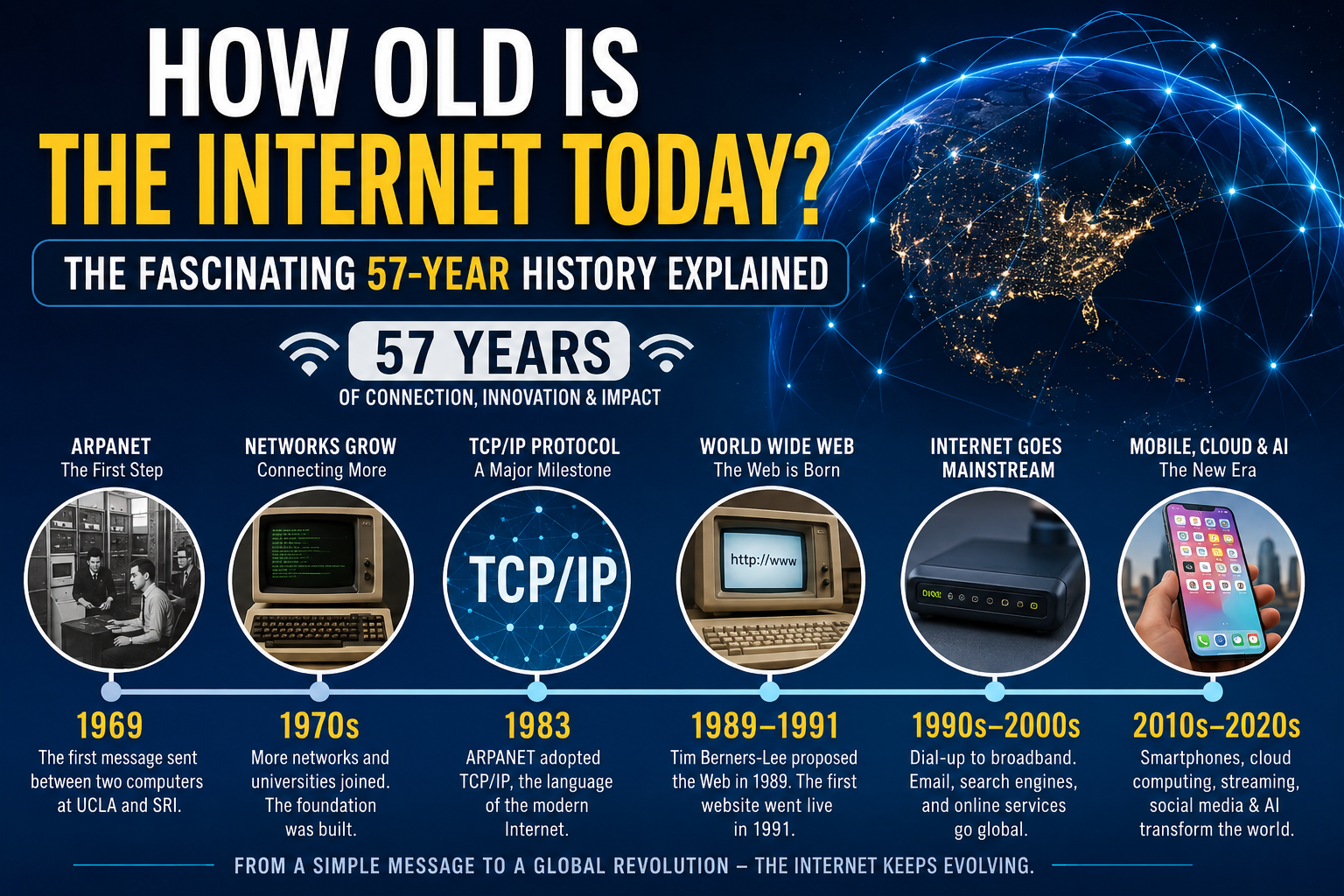
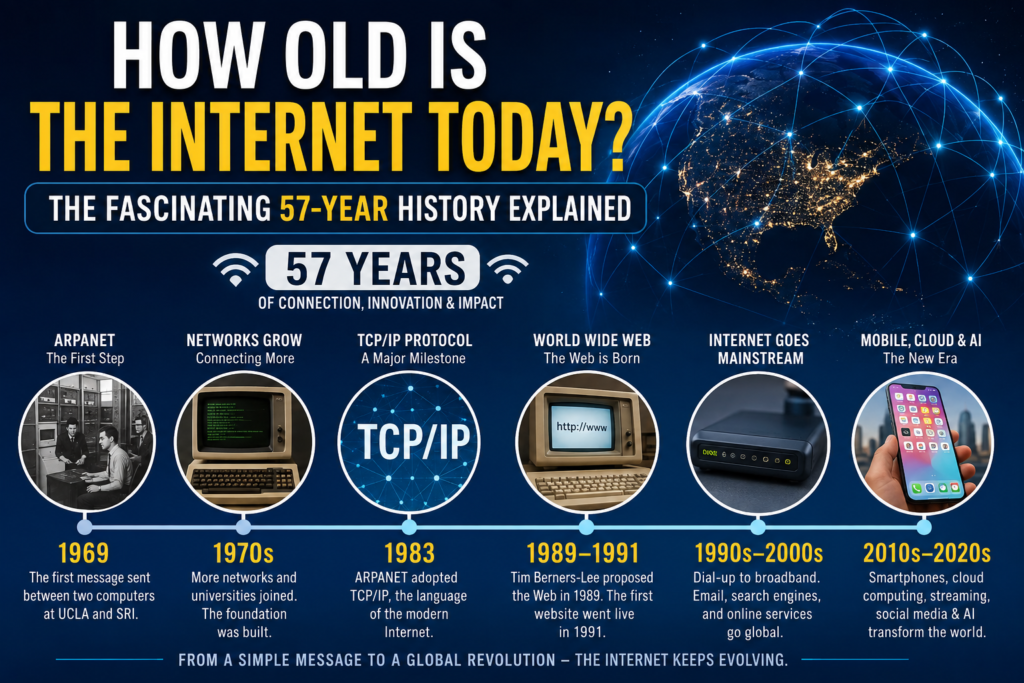
A Simple Internet History Timeline
A quick timeline makes the evolution easier to remember.
1950s–1960s: Researchers explore computer networking, packet switching, and resource sharing.
1969: ARPANET sends its first host-to-host message between UCLA and SRI.
1970s: Researchers develop and refine internetworking concepts and protocols.
1983: ARPANET adopts TCP/IP, an important milestone in the development of the modern Internet.
1989: Tim Berners-Lee proposes the World Wide Web at CERN.
1990: The first Web browser/editor, Web server, and website become operational at CERN.
1991: The World Wide Web is announced on the Internet.
1990s: Consumer Internet access expands rapidly.
2000s: Broadband and online services accelerate adoption.
2010s: Smartphones and mobile connectivity make Internet access increasingly ubiquitous.
2020s: Cloud computing, AI, streaming, IoT, edge computing, and high-speed connectivity continue reshaping the Internet.
This timeline demonstrates why how old is the internet today cannot be answered accurately with a single date without explaining the milestone being measured.
What Academic Research Says About Internet Evolution
Research into Internet history emphasizes that its development was technological, organizational, social, and commercial—not simply a matter of inventing one machine.
A foundational historical paper by Barry Leiner, Vinton Cerf, David Clark, Robert Kahn, Leonard Kleinrock, Jon Postel, and other Internet pioneers describes the Internet’s evolution across technological development, operational infrastructure, community collaboration, and commercialization.
That perspective is valuable because it prevents an overly simplistic version of Internet history.
The Internet became powerful because different innovations reinforced one another.
Packet switching provided an efficient networking model.
TCP/IP allowed networks to communicate.
Domain naming made resources easier to identify.
The Web made information easier to navigate.
Browsers made the Web accessible.
Commercial infrastructure brought scale.
Broadband increased speed.
Mobile networks changed accessibility.
Cloud computing transformed how applications were delivered.
AI is now changing how people interact with online information.
The Internet’s story is therefore one of continuous adaptation.
Why the Internet Is Still Getting “Older” While Changing So Quickly
It may seem contradictory to call the Internet nearly six decades old while describing it as a rapidly evolving technology.
But age and innovation aren’t opposites.
The Internet is better understood as an architecture.
The underlying principles can remain stable while the applications and infrastructure built on top of them change dramatically.
For example, the Internet of 1969 had extremely limited capacity and functionality compared with today’s global network.
Yet both involve computers exchanging information across interconnected networks.
That’s similar to how modern transportation still relies on principles established centuries ago even though today’s vehicles, roads, and navigation systems are radically more advanced.
The Internet’s age describes its historical lineage—not the age of every technology currently running on it.
Is the Internet Older Than Google?
Yes.
Google was founded in 1998.
By then, the Internet had already existed for nearly three decades if we use 1969 as the starting point.
The World Wide Web was already several years old.
This illustrates another common misunderstanding.
Many people associate the Internet with the companies that made it popular.
Google, Amazon, Facebook, YouTube, Netflix, and countless other platforms became major parts of Internet culture long after its technical foundations had been established.
The Internet created an environment in which these services could emerge.
The services did not create the Internet itself.
Is the Internet Older Than the World Wide Web?
Yes—by a significant margin.
If we use 1969 for the Internet’s major precursor and 1989–1991 for the Web, the Internet predates the Web by roughly two decades.
That is perhaps the single most important distinction to remember when answering how old is the internet today.
You can have an Internet without the World Wide Web.
But the Web requires an underlying network such as the Internet to function globally.
Why This History Matters Today
Understanding how old is the internet today isn’t just trivia.
It explains why the Internet is designed the way it is.
Its decentralized structure, layered protocols, interoperability, and ability to connect different networks were shaped by decades of engineering and research.
It also explains why new applications can appear without requiring the entire Internet to be rebuilt.
Websites, apps, streaming platforms, cloud services, social networks, and AI tools can innovate at higher layers while relying on the underlying network architecture.
That flexibility is one of the Internet’s greatest strengths.
It also explains why Internet technology continues to support entirely new categories of services.
Frequently Asked Questions
How old is the internet today?
In 2026, the Internet is approximately 57 years old if October 29, 1969, is used as the key starting point. That date marks the first ARPANET host-to-host message, an important milestone in the Internet’s development.
How old is the internet today compared with the World Wide Web?
The Internet is roughly two decades older than the World Wide Web. The Web was proposed by Tim Berners-Lee in 1989 and became operational at CERN around 1990, with its public announcement occurring in 1991.
Who invented the internet?
There is no single inventor of the Internet. Its development involved many researchers and institutions. Leonard Kleinrock, Vint Cerf, Robert Kahn, Paul Baran, Donald Davies, Larry Roberts, and many others contributed important ideas and technologies.
When did the internet become popular?
Consumer Internet adoption expanded rapidly during the 1990s and accelerated further during the 2000s with broadband access. The rise of smartphones, mobile networks, social media, and cloud services then made Internet connectivity even more widespread.
Was ARPANET the internet?
ARPANET was not identical to today’s Internet, but it was one of its most important predecessors. It demonstrated practical computer networking and provided a foundation for later internetworking technologies.
What is the difference between the internet and the Web?
The Internet is the global network infrastructure, while the World Wide Web is a system of linked resources and services that operates over that network. Email, online games, cloud services, and other applications can use the Internet without being part of the Web.
Final Answer: How Old Is the Internet Today?
So, how old is the internet today?
The clearest answer is approximately 57 years old in 2026, using October 29, 1969, as the key birth milestone associated with ARPANET’s first host-to-host communication.
But that number tells only part of the story.
The Internet emerged from decades of research into networking and packet switching. ARPANET demonstrated early large-scale computer networking. TCP/IP helped create an architecture for connecting different networks. The World Wide Web later transformed Internet information into something much easier for ordinary people to explore.
From dial-up connections to fiber broadband, from desktop computers to smartphones, and from static websites to cloud platforms and artificial intelligence, the Internet has continuously evolved.
The most important lesson is that the Internet is older than the Web, older than Google, older than social media, and older than the smartphone era.
It is not one invention with one birthday. It is the result of decades of engineering, research, experimentation, standards, infrastructure, and human collaboration.
That is what makes the answer to how old is the internet today so fascinating.
The Internet may be nearly six decades old, but its next chapter is still being written.
If you’re researching technology history, digital trends, or the evolution of online communication, understanding these milestones provides a strong foundation for exploring what comes next.