
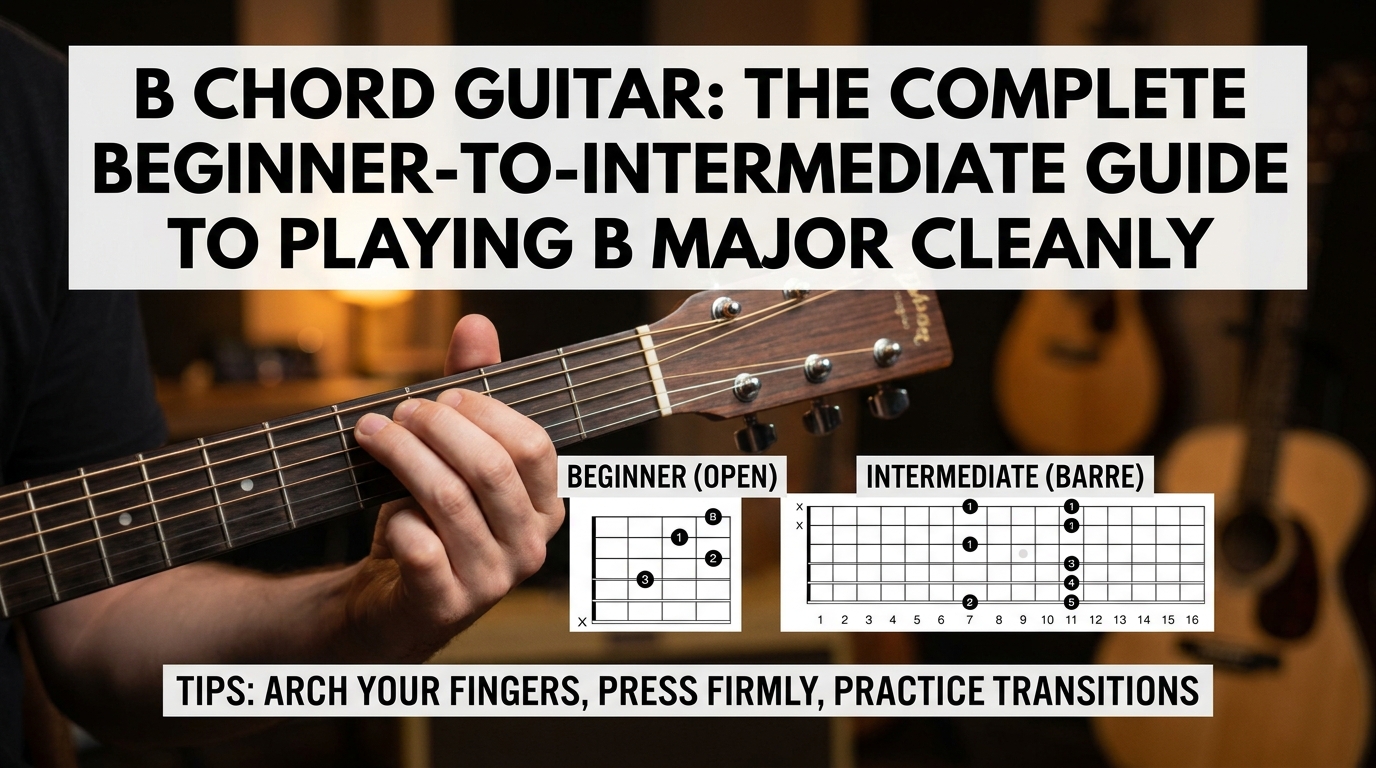
B Chord Guitar: The Complete Beginner-to-Intermediate Guide to Playing B Major Cleanly
If you are learning b chord guitar, you have probably discovered one frustrating truth: B major looks simple on a chord chart, but getting every note to ring clearly can feel much harder than playing G, C, or D. The good news is that the challenge is not a sign that you are doing something wrong. The B chord guitar shape introduces you to an important guitar technique—barre chords—and once you understand the mechanics, it becomes far easier to play confidently.
The B major chord is especially valuable because it appears throughout rock, pop, country, blues, folk, and worship music. Learning it also gives you a practical introduction to movable chord shapes, the CAGED system, fretboard awareness, and efficient left-hand technique.
This guide explains exactly how to play b chord guitar, why it is difficult, which fingering to use, how to avoid buzzing, and how to practice it without building bad habits.
What Is the B Major Chord on Guitar?
The B major chord consists of three notes: B, D#, and F#. B is the root, D# is the major third, and F# is the perfect fifth.
In standard tuning, the most common beginner-friendly version of b chord guitar is an A-shaped barre chord at the second fret. Its commonly written chord shape is:
x24442
The “x” means you do not play the sixth string. The remaining strings produce the notes that form B major.
This is important because B major is not normally played as a traditional open-position chord in standard tuning. Instead, guitarists usually use a barre chord or a smaller partial version.
Fender’s Dan Macy describes it simply: “The B major chord requires a little more effort to learn than other beginner chords.”
That extra effort is mainly caused by the barre technique rather than by complicated music theory.
How to Play B Chord Guitar Step by Step
For the standard b chord guitar shape at the second fret, start with your index finger.
Place your index finger across the second fret from the fifth string through the first string. You are essentially creating a temporary “nut” with your finger.
Next, place your middle finger on the fourth fret of the fourth string.
Place your ring finger on the fourth fret of the third string.
Finally, place your pinky on the fourth fret of the second string.
The sixth string should normally be muted or avoided.
The fingering can therefore be summarized as:
6th string: Do not play
5th string: 2nd fret, index finger
4th string: 4th fret, middle finger
3rd string: 4th fret, ring finger
2nd string: 4th fret, pinky
1st string: 2nd fret, index finger
This is the classic A-shape version of b chord guitar.
Fender identifies this second-position shape as one of the common ways to play B major and recommends strumming four strings down from the A string.
Why Does the Index Finger Need to Bar?
The index finger has to cover multiple strings because the shape is derived from the open A major chord.
If you moved a standard open A shape upward by two frets, the open strings would no longer provide the necessary notes. The index finger effectively replaces the guitar’s nut.
This is the basic idea behind movable barre chords.
Once you understand it, b chord guitar becomes more than a single chord to memorize. It becomes a gateway to dozens of other major chords.
Move the same A-shaped form to the third fret and you have C major.
Move it to the fifth fret and you have D major.
Move it to the seventh fret and you have E major.
The shape stays largely the same; the root note on the fifth string determines the chord name.
Why Is B Chord Guitar So Difficult for Beginners?
Many beginners assume that a difficult chord requires more finger strength. Strength certainly matters, but technique is usually more important.
When learning b chord guitar, beginners often squeeze the neck extremely hard. That can create tension without necessarily improving the sound.
The real goal is to find the minimum amount of pressure required to make each note ring clearly.
Your thumb should provide support behind the neck rather than acting like a vise. Your wrist should remain reasonably relaxed, and your fingers should approach the strings from a useful angle.
Another problem is that the third finger may accidentally touch the first or second string. This can cause muted notes or buzzing.
The shape is also physically demanding because three fingers need to share the same fret while the index finger maintains a partial barre.
This is why b chord guitar can feel awkward even for players who already know several open chords.
The Easiest B Chord Guitar Version
You do not necessarily need to begin with the full four-finger version.
A useful simplified B major shape is:
x2444x
Here, you focus on the A, D, G, and B strings.
The high E string is not played, and the low E string is also omitted.
This smaller version of b chord guitar can be easier because you are not asking your index finger to make both the first and fifth strings ring simultaneously.
It is particularly useful when the song arrangement does not require the highest note.
You can also use partial voicings containing only three notes. These smaller shapes are extremely useful in rhythm guitar because a chord does not always need six strings to sound complete.
In fact, professional guitarists frequently choose smaller chord voicings depending on the musical context.
B Chord Guitar: The Most Important Hand Position Tips
Your index finger should generally be positioned close to the fret rather than directly in the middle of the fret space.
Try slightly rotating the index finger so that the side of the finger—not its softest central portion—contacts the strings.
You do not need to press every string equally hard. If a string is already being fretted by another finger, the index finger’s job may simply be to cover the remaining strings.
Keep your thumb approximately behind the neck rather than wrapping it aggressively over the top while you are learning the barre.
Your elbow should remain relaxed. Avoid pulling your entire arm backward simply to create more pressure.
If you feel significant pain, stop. Normal fingertip fatigue and mild muscular effort are different from sharp or persistent pain.
A technically efficient b chord guitar technique should become easier with practice, not progressively more painful.
How to Test Whether Your B Chord Is Clean
Do not immediately strum all four strings and assume the chord is either correct or incorrect.
Instead, test the chord one string at a time.
Start with the fifth string.
Then play the fourth string.
Move to the third string.
Test the second string.
Finally, test the first string.
Listen carefully.
If one string buzzes, determine exactly which finger is causing the problem.
This diagnostic approach is much more effective than repeatedly strumming a bad chord.
For example, suppose the B string sounds muted. Your ring finger may be leaning too far forward and touching it.
If the high E string buzzes, your index finger may not be applying enough pressure or may be positioned too far from the fret.
If the D string is dead, check whether your middle finger is landing directly behind the fret.
This process turns b chord guitar practice into a problem-solving exercise instead of a frustrating guessing game.
A Better Way to Practice B Chord Guitar
One of the biggest mistakes beginners make is holding the chord for several minutes at a time.
Instead, practice forming it, releasing it, and forming it again.
Try this:
Place your fingers into the B shape.
Hold it for two seconds.
Strum or pick each string.
Release your hand completely.
Repeat.
The purpose is to train your fingers to find the shape efficiently.
Research on musical motor learning supports the importance of combining movement with auditory feedback. A 2022 Scientific Reports study involving 56 guitarists and 59 pianists found meaningful differences in learning under listening, silent motor practice, and audio-motor practice conditions; auditory feedback was particularly relevant for beginners.
In practical terms, that means you should not simply put your fingers into a shape silently and hope they eventually learn it. Listen to what you are producing.
A clean note gives your brain useful feedback.
A buzz, mute, or wrong pitch tells you something needs adjustment.
Practice B Chord Guitar With Short Sessions
Instead of practicing the chord for 30 minutes continuously, consider several short sessions.
For example, spend five minutes working on b chord guitar in the morning, another five minutes later in the day, and another five minutes during your normal playing session.
Distributed practice can help reduce fatigue and give the nervous system repeated opportunities to reinforce the movement.
Research on practice schedules in motor learning indicates that distributing practice can influence persistent learning and temporary fatigue-related performance changes.
This is particularly useful for barre chords because excessive squeezing can quickly tire the hand.
Quality matters more than brute-force repetition.
A 10-Minute B Chord Guitar Practice Routine
Start with two minutes of simple finger placement.
Do not strum yet. Form the chord, release it, and repeat slowly.
Spend the next two minutes checking individual strings.
Play the A, D, G, B, and high E strings separately. Fix any muted or buzzing notes.
For the next two minutes, practice switching between A major and B major.
A major is especially useful because the B major shape is derived from the A-shape barre concept.
Then spend two minutes switching between B and E.
Finally, spend two minutes playing a simple rhythm pattern using B, E, A, and F#.
The goal is not speed.
Your goal is to make the transition predictable.
Eventually, your hand should begin recognizing b chord guitar as a familiar physical pattern rather than a collection of individual finger movements.
B Chord Guitar and the CAGED System
The B major chord becomes much easier to understand when you learn the CAGED system.
CAGED describes five basic movable chord shapes derived from the open C, A, G, E, and D forms.
The B chord is commonly associated with the A-shape barre chord, with its root located on the fifth string.
There is also an E-shape B major chord higher on the neck. Because the E-shape uses the sixth-string root, the B major version occurs at the seventh fret.
The A-shaped version is usually the first one beginners encounter because it sits relatively close to the nut.
Understanding this concept is more powerful than memorizing one b chord guitar diagram.
Once you know where the notes are on the fifth and sixth strings, movable major chords become far easier to understand.
JustinGuitar’s educational material similarly explains B major as an A-shape or E-shape barre chord and emphasizes the importance of movable shapes.
The B Chord Guitar Shape at the Seventh Fret
Another useful form of b chord guitar appears at the seventh fret.
This version is based on the E-shape barre chord.
The index finger bars the seventh fret, while the remaining fingers create the major-chord shape.
Conceptually, it is the same principle as the familiar F major barre chord, but moved up the neck.
The important distinction is the root.
With an E-shaped major barre chord, the root is on the sixth string.
At the seventh fret, the sixth string is B, so the resulting chord is B major.
This gives you another way to play B major and demonstrates why learning movable shapes is so valuable.
B Chord Guitar Versus B7
Do not confuse B major with B7.
B7 is a dominant seventh chord and contains a different collection of notes.
Its common open-position shape is:
x21202
B7 is often easier for beginners than full B major because it uses open strings and does not require the same barre technique. JustinGuitar’s educational community also notes B7 as an easier alternative in certain musical situations.
However, B7 cannot always replace B major.
If a song specifically calls for B major, changing it to B7 alters the harmony.
Use B7 when it fits the musical progression, especially in blues, country, and dominant-function contexts.
Common B Chord Guitar Mistakes
Pressing Too Hard
More pressure does not automatically mean better sound.
Experiment with gradually reducing your grip until the note begins to buzz, then increase pressure slightly.
That teaches your hand how little force is actually necessary.
Playing the Sixth String
The standard second-position B major shape does not normally include the low E string.
If you accidentally strike it, you may hear an unwanted F# or other bass note depending on the exact voicing.
Practice starting your strum from the fifth string.
Collapsing the Index Finger
A weak or poorly positioned index finger can prevent the first and fifth strings from ringing.
Try placing the finger closer to the fret and slightly rolling it toward its bony side.
Lifting All Your Fingers During Chord Changes
Beginners often completely release their hand when moving between chords.
Instead, look for common movement patterns.
For example, when moving between A and B major, some fingers can remain organized around the same A-shaped concept.
Efficient transitions are a major part of mastering b chord guitar.
Practicing Only the Chord Itself
If you can form B major perfectly but cannot change to it during a song, the chord is not yet functional.
Practice transitions.
Musical ability depends on movement in context, not simply static chord formation.
Mini Case Study: From Buzzing B to Usable B
Imagine a beginner who can play G, C, D, and Em comfortably but constantly struggles with B.
At first, every attempt produces buzzing on the first and second strings.
Instead of practicing the full chord for 20 minutes, the player reduces the shape to x2444x and works on clean individual notes.
After several short sessions, the partial chord becomes reliable.
The player then adds the high E string and practices switching between A and B at a slow tempo.
Finally, B is introduced into a real chord progression.
This progression is important.
The guitarist is not merely developing finger strength. They are building position awareness, finger independence, timing, auditory feedback, and transition efficiency.
That is exactly why isolated chord drills should eventually be connected to real music.
How Long Does It Take to Learn B Chord Guitar?
There is no universal timeline.
A beginner with no barre-chord experience may need several days or weeks before the chord feels natural.
Someone who already knows F major, minor barre chords, and movable power chords may learn it much faster.
Your guitar also matters.
An acoustic guitar with high action and heavy strings can make barre chords feel substantially harder than a well-set-up electric guitar.
If your guitar requires excessive pressure to fret normal notes, having the setup checked by a qualified technician may make practice considerably more comfortable.
The goal is not to ask, “How quickly can I master b chord guitar?”
A better question is:
“Can I produce the chord cleanly and transition into it without unnecessary tension?”
That is a more meaningful measure of progress.
Why Practice Quality Matters More Than Repetition
A large number of incorrect repetitions can reinforce inefficient movement.
Research into musical motor learning shows that practice changes how movements are organized, while studies of experienced guitarists have found differences in motor-planning activity compared with non-musicians.
That does not mean beginners need to think about neuroscience while playing.
It means your practice should be deliberate.
If the chord consistently buzzes, stop and diagnose it.
If your wrist becomes tense, reset your position.
If you can play it alone but miss it during a song, practice the transition rather than repeating the stationary chord.
This approach makes b chord guitar practice more efficient.
Using B Chord Guitar in Real Chord Progressions
Once the chord feels comfortable, use it musically.
Try:
A – B – D – E
Then:
E – B – A – E
You can also practice:
B – E – F# – B
The second progression is particularly useful because B, E, and F# have strong relationships within the key of B major.
Do not worry about complicated strumming at first.
Use four slow downstrokes per chord.
Once the changes are clean, add a simple pattern such as:
Down – Down – Up – Up – Down – Up
The purpose is to make b chord guitar part of your normal playing vocabulary.
Acoustic Guitar vs. Electric Guitar for B Chord Guitar
If you are learning b chord guitar on acoustic guitar, you may initially find it demanding because acoustic strings can require more fretting force.
An electric guitar often feels easier because of lower string tension and different action.
That does not mean you need an electric guitar to learn B major.
It simply means that equipment can influence the difficulty you experience.
If your acoustic guitar feels unusually difficult, check the action, string gauge, and setup before assuming your hands are the problem.
A properly adjusted instrument can make a major difference in comfort.
B Chord Guitar for Left-Handed Players
Left-handed guitarists can use the same musical principles.
The physical finger positions will be mirrored depending on how the guitar is configured, but the chord itself remains B major.
What matters most is following a diagram designed for your playing orientation.
Do not judge your technique by comparing the visual appearance of your hand with another guitarist.
Focus on whether the correct notes are sounding clearly and whether your movement is relaxed and repeatable.
Should Beginners Learn B Major Before F Major?
There is no universal rule.
Both can be challenging because both commonly use barre techniques.
However, B major can be a useful introduction to the A-shape barre chord because the barre begins at the second fret rather than the first.
That can make it feel slightly more forgiving for some learners.
F major, meanwhile, introduces the E-shape barre chord.
Learning one gives you valuable preparation for the other because both demonstrate the fundamental idea of movable chord shapes.
The best choice depends on the songs you want to play.
Frequently Asked Questions About B Chord Guitar
Is B major hard to play on guitar?
Yes, B major is commonly considered more difficult for beginners because the standard shape uses a barre chord. The challenge is primarily coordination, finger placement, and efficient pressure—not simply hand strength. Fender also describes B major as requiring more effort than many beginner chords.
What is the easiest B chord guitar shape?
A partial B major such as x2444x is often easier than the full x24442 shape because it reduces the number of strings you need to fret and control. It is useful for practice and can work musically when the omitted notes are not essential.
Can I play B major without a barre?
Yes. You can use partial chord voicings or alternative arrangements. However, the standard second-position B major shape is an A-shaped barre chord. In standard tuning, B major is not normally available as a conventional open-position major chord.
Why does my B chord sound muted?
The most common causes are insufficient index-finger contact, poor finger angles, another finger accidentally touching a string, or excessive tension. Test each string individually rather than repeatedly strumming the entire chord.
How can I switch to B major faster?
Practice transitions rather than only holding the chord. Choose two chords, such as A and B, and switch between them slowly for several repetitions. Once the movement becomes reliable, gradually increase the tempo.
Is B7 the same as B major?
No. B7 and B major have different notes and different harmonic functions. B7 can sometimes substitute for B major in specific musical contexts, but it should not be treated as an identical chord.
Final Thoughts on B Chord Guitar
Learning b chord guitar is one of those milestones that can make your playing feel dramatically more advanced. At first, the shape may seem uncomfortable, your fingers may feel crowded, and the chord may buzz no matter how carefully you strum.
That stage is normal.
The solution is not to squeeze harder. Build the shape gradually, use a partial version when necessary, check each string individually, and practice transitions instead of relying only on static repetition.
Most importantly, connect your practice to actual music. Research on musical learning shows that auditory feedback and purposeful motor practice can play an important role in developing performance skills, particularly for newer musicians.
Once b chord guitar becomes comfortable, you gain much more than one new chord. You begin to understand movable shapes, barre technique, the fifth-string root system, and the logic behind the CAGED approach.
Give yourself time, keep your hand relaxed, and focus on clean repetitions. With consistent practice, the B major chord can move from one of the most frustrating shapes on the neck to one of the most useful tools in your guitar vocabulary.






One Comment