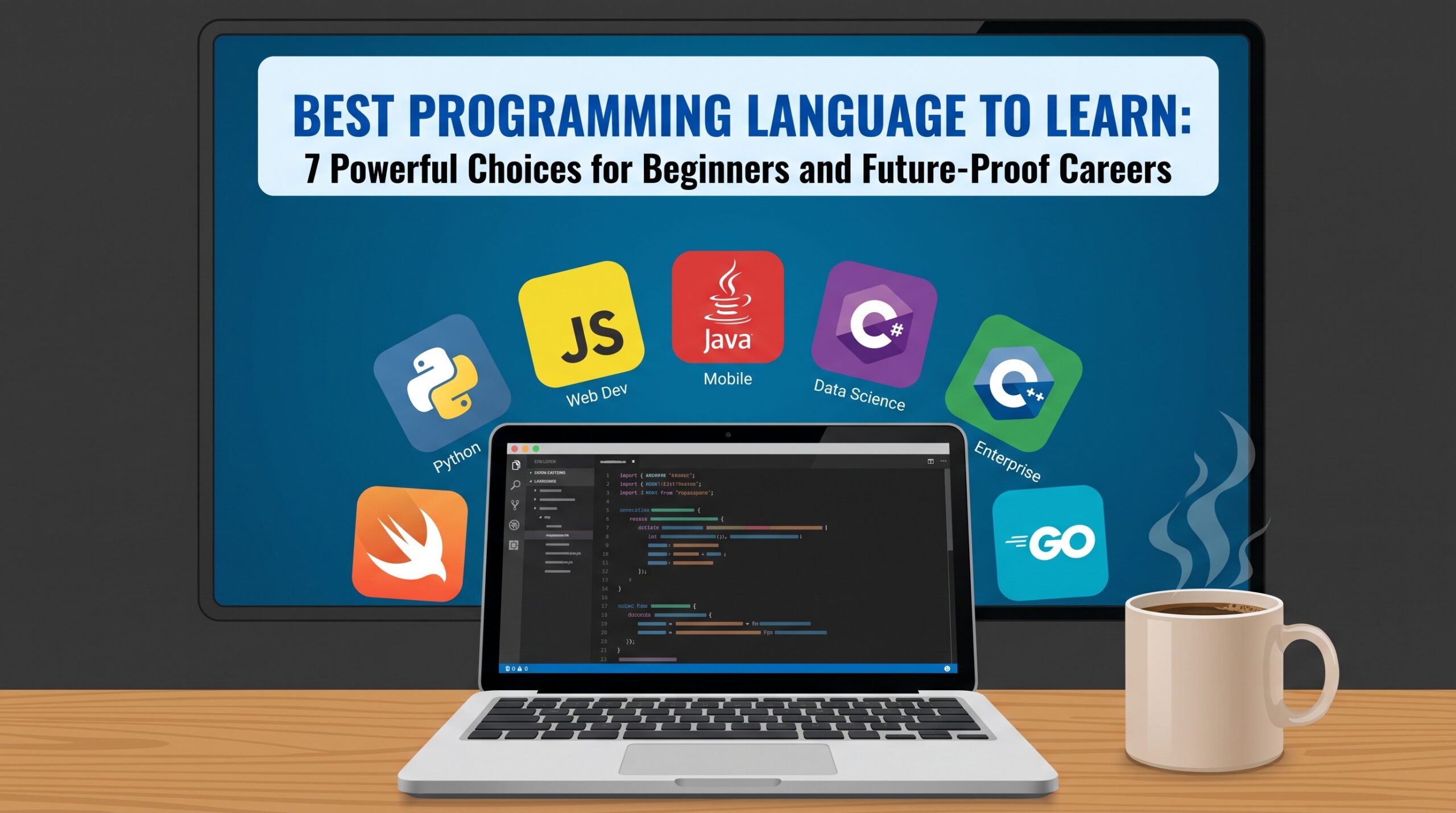
best programming language to learn: 7 Powerful Choices for Beginners and Future-Proof Careers
Choosing the best programming language to learn can feel overwhelming. Python, JavaScript, TypeScript, Java, C#, C++, Go, and Rust all have strong communities, real-world applications, and career opportunities. The right choice, however, depends less on which language is “the most popular” and more on what you want to build, how you want to work, and where you want your career to go.
For most beginners in the United States, Python is the strongest all-around starting point because it combines relatively approachable syntax with applications in artificial intelligence, data science, automation, backend development, education, and scientific computing. But Python is not automatically the best answer for everyone. Someone focused on websites may benefit more from JavaScript or TypeScript, while an aspiring Android developer, game developer, systems engineer, or enterprise developer may have very different priorities.
Current industry data supports this broader view. IEEE Spectrum’s 2025 ranking placed Python first in its overall ranking and its Jobs ranking, while noting that SQL remains highly valuable to employers. GitHub’s 2024 Octoverse report also found Python had become the most-used language on GitHub, with JavaScript, TypeScript, and Java continuing to have enormous developer communities.
So, what is the best programming language to learn in 2026? Let’s compare the leading choices by career path, difficulty, earning potential, versatility, and long-term usefulness.
What Makes a Programming Language Worth Learning?
Before deciding on the best programming language to learn, it helps to understand what actually makes a language valuable.
Popularity is one factor, but it should never be the only one. A language can have millions of developers yet be a poor first choice for your particular career goal.
A better evaluation considers learning curve, job demand, ecosystem size, community support, versatility, performance, development tools, and future relevance.
The current developer landscape also shows why popularity alone can be misleading. IEEE Spectrum’s methodology combines signals such as web activity, Stack Overflow references, job postings, books, GitHub activity, and other indicators rather than treating one metric as definitive.
Stack Overflow’s 2025 Developer Survey collected more than 49,000 responses from 177 countries. It reported that 69% of developers had spent time learning a new coding technique or programming language during the previous year, showing that successful developers routinely continue learning rather than relying on one language forever.
That leads to an important principle: your first programming language does not need to be your last programming language.
The goal is to learn fundamental programming concepts deeply enough that moving to another language becomes easier.
best programming language to learn for Most Beginners: Python
If you have no programming experience and want one language that opens many doors, Python is arguably the best programming language to learn today.
Python uses relatively clean syntax, which allows beginners to concentrate on concepts such as variables, loops, functions, data structures, algorithms, and object-oriented programming instead of spending excessive time learning complicated syntax.
Its usefulness is equally important.
Python is widely used for artificial intelligence, machine learning, data analysis, automation, scientific computing, backend development, scripting, cybersecurity, testing, and education.
GitHub reported that Python became its most-used language in 2024, overtaking JavaScript after JavaScript’s decade-long run at the top. GitHub specifically connected Python’s growth with AI, data science, scientific computing, and the expansion of Jupyter Notebook usage.
Stack Overflow’s 2025 survey also reported a seven-percentage-point increase in Python adoption from 2024 to 2025, identifying AI, data science, and backend development as important areas behind its continued growth.
Why Python Is So Beginner-Friendly
Consider a beginner who wants to create a simple automation program.
In Python, the syntax is generally straightforward enough that the learner can quickly see the relationship between the instructions and the result.
That matters because early programming success creates momentum. A beginner who can build a useful calculator, automate a repetitive task, analyze a spreadsheet, or create a small web application has a concrete reason to continue learning.
Python also has an enormous ecosystem.
Libraries such as NumPy, pandas, PyTorch, Django, FastAPI, and many others allow developers to build sophisticated applications without implementing every capability from scratch.
Python and Artificial Intelligence
AI has significantly strengthened Python’s position.
Machine learning workflows frequently use Python because the ecosystem provides extensive libraries for numerical computing, data manipulation, visualization, and machine learning.
That does not mean every AI engineer only needs Python. Production systems may involve C++, Java, Rust, JavaScript, TypeScript, CUDA, SQL, and cloud technologies.
Nevertheless, Python provides an unusually accessible entry point into AI programming and machine learning.
GitHub’s Octoverse data supports this connection, reporting that Python’s rise coincided with increased activity in AI, data science, and Jupyter Notebooks.
JavaScript: The best choice for Web Development
If your primary goal is to build websites and interactive web applications, JavaScript may be the for your particular path.
JavaScript powers behavior inside web browsers and has expanded far beyond traditional front-end development.
Modern JavaScript can also be used on servers through environments such as Node.js, while frameworks and libraries support everything from user interfaces to full-stack applications.
For someone who says, “I want to become a web developer,” JavaScript is difficult to ignore.
You can learn HTML and CSS alongside JavaScript and eventually progress toward frameworks such as React, Vue, or Angular.
The ecosystem is enormous, and developers can create everything from simple interactive websites to complex web applications.
Stack Overflow’s 2025 survey listed JavaScript at 66% usage among respondents, demonstrating how deeply established the language remains.
Why Learn JavaScript?
JavaScript offers an unusually direct connection between learning and visible results.
A beginner can write code, refresh a browser, click a button, and immediately see the result.
That feedback loop can make learning engaging.
JavaScript is also particularly valuable because modern web development increasingly involves full-stack concepts. A developer can use JavaScript or TypeScript across different layers of an application, reducing the number of completely different technologies they need to master initially.
TypeScript: A Strong Modern Choice for Professional Web Apps
TypeScript deserves special attention when discussing the because it builds upon JavaScript rather than replacing it.
TypeScript adds static typing and other development features that can make large applications easier to maintain.
GitHub’s 2024 data placed TypeScript third among its most-used languages, behind Python and JavaScript. GitHub also noted that TypeScript’s growth reflects its usefulness within the JavaScript ecosystem and its ability to gradually transition existing JavaScript developers.
For a beginner, however, jumping directly into TypeScript may not always be necessary.
A practical route is:
HTML → CSS → JavaScript → TypeScript → React or another modern framework
This sequence gives learners an understanding of what TypeScript is solving instead of treating it as mysterious additional syntax.
For professional frontend and full-stack development, TypeScript can be an excellent long-term investment.
Java: A Powerful Option for Enterprise Software
Java may not receive as much beginner-focused attention as Python, but it remains an important language for professional software development.
Java has been used extensively in enterprise applications, backend systems, financial technology, large-scale platforms, and Android development.
One of its major advantages is longevity.
Learning Java exposes students to concepts that transfer well to other languages, including object-oriented programming, data structures, interfaces, classes, inheritance, exception handling, and software architecture.
Java is also widely represented in GitHub’s language ecosystem. GitHub’s 2024 ranking placed Java fourth among its top languages.
If your objective is a career in enterprise software development, Java remains a sensible choice.
It may not feel as immediately approachable as Python, but learning Java thoroughly can develop strong programming discipline.
C#: Excellent for .NET and Game Development
C# is another strong candidate when deciding on the best programming language to learn particularly if you are interested in Microsoft’s .NET ecosystem or game development.
C# is widely associated with .NET, which supports web applications, APIs, desktop applications, cloud software, and enterprise systems.
C# is also strongly associated with the Unity game engine, making it attractive to aspiring game developers.
The language provides modern features while retaining the structured approach expected from a statically typed programming language.
For a beginner interested in software engineering rather than purely scripting, C# can provide a valuable foundation.
It teaches concepts that become useful when working with large codebases, including types, interfaces, classes, dependency management, testing, and architecture.
C++: The Choice for Performance and Systems
C++ is rarely the easiest answer to the question “What is the best programming language to learn for a complete beginner?”
But it can be one of the best choices for a specific type of learner.
C++ is heavily associated with systems programming, game engines, high-performance applications, embedded systems, robotics, finance, graphics, and performance-critical software.
Its learning curve is steeper because developers need to understand more details about memory, types, compilation, object lifetimes, and system behavior.
That difficulty is also part of its educational value.
Learning C++ can give developers a deeper understanding of how software interacts with computers.
However, if your immediate objective is to build websites, automate business tasks, or explore AI, Python or JavaScript will generally provide a faster route to useful projects.
Rust: A Modern Language for Systems Programming
Rust is one of the most interesting options for developers who want to work close to the hardware while maintaining strong memory-safety guarantees.
GitHub reported continued growth in Rust and specifically highlighted its safety, performance, and productivity.
Rust is increasingly relevant to infrastructure, operating-system components, networking, security-sensitive software, and performance-focused applications.
It is not necessarily the best programming language to learn first for everyone.
Its concepts can challenge beginners, particularly around ownership, borrowing, lifetimes, and memory management.
But for someone who already understands programming and wants to specialize in systems development, Rust can be an excellent second language.
Go: A Practical Language for Cloud and Backend Development
Go, often called Golang, is designed around simplicity, efficient compilation, concurrency, and practical software engineering.
It has become especially relevant to backend services, cloud infrastructure, networking, DevOps tooling, and distributed systems.
Go is attractive because it provides a relatively straightforward syntax while supporting professional-scale software.
For someone targeting cloud engineering or backend development, Go can be a smart specialization.
It also teaches useful ideas around concurrency and software architecture.
However, beginners who do not yet know programming fundamentals may find Python more accessible as a first language.
SQL: The Skill You Should Learn Alongside Programming
SQL is technically different from general-purpose programming languages, but no discussion of the best programming language to learn for modern careers should ignore it.
SQL is used to communicate with relational databases.
If you work in software engineering, data analytics, business intelligence, backend development, data science, or AI, you will likely encounter databases.
IEEE Spectrum’s 2025 Jobs ranking specifically highlighted SQL as an extremely valuable skill for resumes, even though Python occupied the top position.
That makes SQL an excellent companion skill.
A Python developer who understands SQL is considerably more versatile than someone who only knows Python syntax.
Likewise, JavaScript developers building applications frequently need to understand databases and data modeling.
Think of SQL as part of the broader software development toolkit, not merely another language to collect.
The best programming language to learn by Career Goal
There is no universal winner because programming careers are highly specialized.
If you want to enter AI or machine learning, Python is the strongest starting point.
If you want frontend web development, JavaScript is difficult to beat.
If you want modern enterprise web development, consider TypeScript, Java, C#, or Python, depending on the ecosystem you target.
For Android development, Kotlin is an important choice.
For iOS development, Swift is the natural ecosystem choice.
For game development, C# and C++ are particularly relevant depending on the engine and type of game.
For systems programming, C++, Rust, and C remain highly important.
For cloud infrastructure and backend services, Go, Java, Python, TypeScript, Rust, and C# can all be strong choices.
For data analytics, Python and SQL form an especially powerful combination.
For cybersecurity, Python can be an accessible starting point, while deeper systems knowledge may eventually lead you toward C, C++, Rust, scripting, networking, and operating-system concepts.
The lesson is simple: choose the language that matches the work you want to perform.
A Mini Case Study: Two Beginners, Two Different Choices
Imagine two people in the United States starting their programming careers.
Alex wants to become a data analyst and eventually work in machine learning.
Jordan wants to become a frontend developer who creates sophisticated websites.
If both ask for the best programming language to learn, giving them the same answer would be poor advice.
Alex should start with Python, then add SQL, pandas, statistics, data visualization, and eventually machine learning frameworks.
Jordan should begin with HTML and CSS, then learn JavaScript before progressing toward TypeScript and a frontend framework.
Neither learner chose incorrectly.
They simply optimized for different outcomes.
This is why online lists claiming that one language is universally superior can be misleading.
What Experts and Industry Data Tell Us
The evidence increasingly suggests that programming language popularity is becoming more dynamic.
IEEE Spectrum’s 2025 analysis placed Python at the top of its overall ranking and Jobs ranking, but it also warned that AI-assisted programming is making traditional popularity measurements harder to interpret.
GitHub’s data tells another useful story: Python rose sharply while TypeScript continued gaining ground and JavaScript remained enormous.
Guido van Rossum, Python’s creator, also discussed this changing environment with GitHub in 2025. When shown Python’s changing position in GitHub’s language data, he expressed surprise at the scale of the shift while noting that Python continues to play a major role in AI, science, and education.
“I was very surprised by that number.”
— Guido van Rossum, creator of Python, discussing GitHub’s changing language-usage data.
The broader lesson is important: language rankings are useful signals, not permanent laws.
How AI Is Changing the best programming language to learn
Artificial intelligence has changed how beginners and professionals write software.
AI coding assistants can generate functions, explain errors, suggest architectures, write tests, and convert code between languages.
That might make it tempting to believe that learning a programming language no longer matters.
The opposite is closer to reality.
AI can generate code, but developers still need to understand whether that code is correct, secure, maintainable, efficient, and appropriate for the problem.
IEEE Spectrum noted that AI assistants are changing the signals traditionally used to measure programming-language popularity because developers can increasingly ask AI systems for answers rather than searching public programming forums.
The most valuable skill, therefore, is not memorizing syntax.
It is learning how to think computationally.
Variables, functions, algorithms, data structures, debugging, testing, APIs, databases, networking, version control, and software architecture remain valuable even when AI writes part of the implementation.
How to Choose Your First Programming Language
Start with your desired outcome.
Ask yourself what you want to build during the next six to twelve months.
If the answer is AI tools, automation, data analysis, or machine learning, start with Python.
If you want to build websites and interactive applications, start with JavaScript.
If you want enterprise applications, consider Java or C#.
If you want high-performance software, investigate C++, Rust, or C.
If you want cloud infrastructure, Go is worth considering.
If you want Apple applications, learn Swift.
If you want Android applications, Kotlin deserves serious consideration.
Then choose one language and stay with it long enough to build real projects.
Do not spend three months comparing languages without writing meaningful software.
A Practical 6-Month Learning Roadmap
Your first month should focus on fundamentals.
Learn variables, data types, operators, conditionals, loops, functions, collections, errors, and basic debugging.
During months two and three, build small projects.
Do not simply watch tutorials. Build a calculator, file organizer, API client, web application, automation script, data dashboard, or simple game depending on your chosen language.
Months four and five should introduce more professional practices.
Learn Git, GitHub, testing, documentation, debugging, APIs, databases, and basic software architecture.
By month six, build one substantial portfolio project.
The project should solve a real problem rather than simply demonstrate that you completed a tutorial.
For example, a Python learner could build a data-analysis dashboard.
A JavaScript learner could create a full-stack task management application.
A C# learner could create a small game.
A Go learner could build a REST API.
The project matters because employers generally need evidence that you can apply knowledge, not merely name programming languages on a résumé.
Common Mistakes Beginners Should Avoid
One of the biggest mistakes is trying to learn five languages simultaneously.
Programming concepts become easier when you repeatedly apply them in one environment.
Another mistake is focusing too heavily on syntax.
Modern developers can look up syntax quickly. Understanding why code works is much more important.
A third mistake is relying entirely on AI-generated code.
Use AI as a learning assistant, but make yourself explain every important section of code.
If an AI-generated function breaks, you should eventually be capable of debugging it rather than simply generating another version.
Another mistake is ignoring fundamentals.
Frameworks change. Libraries change. Cloud services change. AI tools change.
Core programming concepts remain much more stable.
What Employers Actually Want
The best programming language to learn is only one part of becoming employable.
Employers also value problem-solving, communication, debugging, collaboration, version control, testing, system design, databases, APIs, and the ability to understand an unfamiliar codebase.
Stack Overflow’s 2025 survey found that technical documentation was the most-used learning resource, with nearly 68% of respondents reporting its use during the previous year.
That is a useful lesson for beginners.
Do not become dependent on tutorials.
Learn how to read official documentation.
Learn how to search for technical answers.
Learn how to reproduce bugs.
Learn how to inspect error messages.
Learn how to read other people’s code.
These skills separate someone who has completed a programming course from someone who can actually function as a developer.
Is Python Still the best programming language to learn in 2026?
For a general beginner, yes, Python remains one of the strongest choices.
Its combination of readable syntax, enormous ecosystem, AI relevance, data-science adoption, automation capabilities, and broad educational use makes it unusually versatile.
Current independent signals reinforce that conclusion. IEEE Spectrum ranked Python first in its 2025 overall and Jobs rankings, while GitHub reported Python as its most-used language in its 2024 Octoverse analysis.
But “best” does not mean “only.”
If you know you want to become a frontend developer, JavaScript may be the better first choice.
If you want iOS development, Swift makes more sense.
If your ambition is systems programming, C++ or Rust could provide a better foundation.
Your career objective should determine your language.
Frequently Asked Questions
What is the best programming language to learn for beginners?
Python is generally one of the strongest first choices because its syntax is approachable and its ecosystem covers AI, automation, data science, backend development, and scientific computing. However, JavaScript may be a better starting point for someone specifically interested in web development.
Should I learn Python or JavaScript first?
Choose Python if you are interested in AI, data science, automation, backend development, or general programming. Choose JavaScript if your primary objective is frontend or full-stack web development.
What programming language has the most career opportunities?
There is no single language that guarantees the most opportunities. Python, JavaScript, TypeScript, Java, C#, and other established languages all support substantial job markets. Your location, industry, experience, and specialization matter as much as the language itself.
Is coding still worth learning with AI?
Yes. AI can accelerate coding, but developers still need programming fundamentals, debugging ability, system understanding, security awareness, and judgment. AI makes technical understanding more useful, not irrelevant.
How long does it take to learn a programming language?
You can learn basic syntax and programming concepts within several weeks, but becoming job-ready usually requires months of consistent practice and project development. The timeline depends heavily on your previous experience and the complexity of your target career.
Should I learn more than one programming language?
Eventually, yes. But beginners should usually become comfortable with one language before adding another. Once you understand variables, functions, data structures, algorithms, debugging, and software design, learning a second language becomes substantially easier.
Final Verdict: What Is the best programming language to learn?
So, what is the best programming language to learn?
For most beginners, Python is the best overall starting point because it combines accessibility with exceptional versatility. It provides pathways into AI, machine learning, data science, automation, backend development, scientific computing, and countless other areas.
But the best programming language to learn depends on your destination.
Choose JavaScript for web development, TypeScript for modern large-scale JavaScript applications, Java for many enterprise environments, C# for .NET and game development, C++ or Rust for performance-oriented systems work, Go for many cloud and backend applications, and SQL as an essential complementary database skill.
Most importantly, don’t chase rankings endlessly.
Pick one language, learn the fundamentals, build real projects, read documentation, use Git, practice debugging, and gradually develop the ability to solve problems independently.
The best programming language to learn is ultimately the one that helps you turn your specific career goal into working software.
And if you’re completely undecided, start with Python, build three real projects, and then choose your specialization. That simple approach will take you much further than spending months trying to identify a perfect language that does not exist.