
Organic SEO Services: 11 Proven Strategies to Grow Sustainable Google Traffic
If you want your website to attract qualified visitors without paying for every click, organic SEO services can provide a sustainable path to long-term growth. Unlike paid advertising, organic search optimization focuses on improving your website’s visibility in unpaid search results through better content, technical performance, user experience, authority, and relevance. For U.S. businesses competing for attention on Google, understanding how these services work—and how to evaluate a provider—can make the difference between steady organic growth and months of wasted effort.
The challenge is that SEO has become far more sophisticated than simply adding keywords to a webpage. Search engines must understand content, interpret search intent, evaluate quality, discover relationships between topics, and determine which pages provide the most useful experience. That means a successful SEO strategy needs to combine technical SEO, content marketing, keyword research, on-page optimization, digital PR, link acquisition, local SEO, analytics, and continuous improvement.
Google’s current guidance emphasizes helpful, reliable, people-first content rather than content created primarily to manipulate rankings. It also states that SEO can be useful when it supports content created for people.
This guide explains what organic SEO services include, why they matter, how they work, what they cost, what results to expect, and how to choose an SEO partner that focuses on sustainable business outcomes.
What Are Organic SEO Services?
Organic SEO services are professional search engine optimization activities designed to improve a website’s unpaid visibility on search engines. Instead of purchasing advertisements for specific keywords, the goal is to make webpages more relevant, useful, technically accessible, and authoritative so they can earn stronger organic rankings.
A comprehensive campaign may include keyword research, competitor analysis, technical audits, content strategy, on-page SEO, internal linking, digital PR, link building, local search optimization, conversion optimization, and performance reporting.
The central idea is simple: earn visibility instead of renting it.
Paid search can produce immediate exposure, but traffic generally stops when the advertising budget stops. Organic visibility can continue generating visitors after a page has earned strong rankings, although maintaining those results requires ongoing optimization because competitors, search behavior, websites, and search systems change.
Google’s SEO Starter Guide describes SEO as helping search engines understand content and helping users discover a website through search.
Why Organic SEO Services Matter for U.S. Businesses
The U.S. online marketplace is crowded. A local service provider, SaaS company, ecommerce store, law firm, healthcare organization, or B2B company may compete with hundreds or thousands of websites for relevant searches.
That makes visibility a strategic business asset.
Imagine a company selling commercial accounting software. It could purchase advertisements for terms such as “accounting software for small business.” However, a strong organic strategy could also build pages around related searches such as “best accounting software for small companies,” “small business accounting automation,” “how to automate bookkeeping,” and “accounting software comparison.”
One useful page may eventually rank for dozens or hundreds of related searches.
That is one of the major advantages of organic SEO services: a successful page can capture demand across an entire topic rather than relying on one exact keyword.
Organic search also attracts users who are actively researching a problem. Someone searching for “emergency roof repair near me” has a very different level of intent from someone casually scrolling through an advertisement.
The right SEO strategy connects the right page with the right searcher at the right stage of the buying journey.
Organic SEO Services vs. Paid Search
SEO and paid search are not enemies. They are different channels that can work together.
Paid search gives businesses greater control over immediate visibility. You choose a budget, target audiences and keywords, create advertisements, and pay when users interact with them.
Organic search takes a different approach. It requires investment in the website and its content, followed by time, testing, measurement, and continuous improvement.
A business might use PPC to generate leads immediately while its organic SEO services campaign builds long-term search visibility.
This combined approach can be especially effective for competitive industries. Paid campaigns provide short-term demand capture while organic optimization works toward sustainable acquisition.
The key distinction is that SEO does not guarantee a particular position. Google explicitly notes that following SEO best practices does not guarantee that a page will be crawled, indexed, or displayed in search results.
Therefore, any provider promising guaranteed number-one rankings should be treated cautiously.
What Do Organic SEO Services Include?
A professional SEO campaign is usually made up of several connected disciplines rather than one isolated activity.
1. SEO Audit and Website Analysis
The process often starts with a detailed audit.
An SEO professional examines how search engines can crawl and index the site, how pages are organized, whether important pages have technical problems, and whether content satisfies user intent.
The audit may identify:
- Indexing problems
- Broken internal links
- Duplicate or thin content
- Poor page architecture
- Missing metadata
- Slow-loading pages
- Mobile usability problems
- Weak internal linking
- Canonicalization issues
- Redirect problems
- Poor keyword targeting
- Weak conversion paths
A good audit does not simply produce a giant spreadsheet of errors. It prioritizes problems according to their likely business impact.
Fixing a critical indexing issue is usually more valuable than spending hours changing minor metadata across hundreds of pages.
2. Keyword Research and Search Intent
Keyword research is one of the foundations of organic SEO services, but modern research goes beyond finding phrases with high search volume.
The real question is:
What does the searcher actually want?
Consider the difference between these searches:
“running shoes”
“best running shoes for beginners”
“men’s running shoes for flat feet”
“buy men’s running shoes”
Each query suggests a different intent.
The first is broad and ambiguous. The second is informational and commercial. The third is highly specific. The fourth demonstrates stronger transactional intent.
Effective keyword research maps these different intents to appropriate pages.
Instead of creating dozens of shallow pages for slightly different keyword variations, a strong SEO strategy builds comprehensive resources capable of satisfying multiple closely related searches.
3. Technical SEO
Technical optimization helps search engines discover, crawl, interpret, and index website content.
Technical organic SEO services may address website architecture, XML sitemaps, robots.txt, canonical URLs, redirects, structured data, JavaScript rendering, mobile usability, page speed, HTTPS, and crawl efficiency.
Technical SEO does not mean making a website complicated. In many cases, the best technical strategy is about removing unnecessary complexity.
For example, an ecommerce site might have thousands of filter combinations creating URLs that provide little unique value. A technical SEO specialist can help search engines understand which URLs matter and which should not consume unnecessary crawl resources.
Google recommends making key information available in text and explains that structured data can help Google understand page content and, in some cases, make pages eligible for enhanced search features.
4. On-Page SEO
On-page optimization improves the information and structure of individual pages.
This can include:
- SEO titles
- Meta descriptions
- Headings
- Introductory copy
- Keyword alignment
- Content structure
- Image alt text
- Internal links
- Descriptive URLs
- Entity references
- Supporting media
- Calls to action
The goal is not to repeat the same keyword repeatedly.
Instead, the page should clearly communicate its subject while naturally covering related concepts and questions.
For example, a page targeting “commercial insurance for contractors” might naturally discuss general liability insurance, workers’ compensation, construction insurance, coverage limits, certificates of insurance, claims, exclusions, and risk management.
That creates semantic depth without awkward keyword stuffing.
5. Content Strategy
Content is where organic SEO services can create a powerful competitive advantage.
A strong content strategy identifies gaps between what users search for and what competitors currently provide.
Rather than publishing generic blog posts every week, an SEO team may create:
- Pillar pages
- Supporting articles
- Comparison guides
- Buying guides
- Case studies
- Original research
- Industry reports
- FAQs
- Glossaries
- Product documentation
- Location pages
The objective is topical authority.
Suppose a cybersecurity company wants to rank for “zero trust security.” A single article may not establish strong topical coverage.
A better strategy could cover zero trust architecture, identity verification, endpoint security, network segmentation, implementation frameworks, common mistakes, compliance considerations, and real-world applications.
These pages can be interconnected through strategic internal links, creating a useful knowledge ecosystem.
6. Link Building and Digital Authority
Links remain an important part of how the web connects information.
But quality matters far more than simply accumulating large numbers of backlinks.
Effective organic SEO services may involve digital PR, expert commentary, original research, resource outreach, editorial partnerships, industry publications, and genuinely useful content that naturally earns references.
A link from a respected, relevant publication can be substantially more meaningful than hundreds of unrelated directory links.
This is why businesses should ask SEO providers where their links come from and how those links are earned.
Avoid providers that promise thousands of backlinks at suspiciously low prices without explaining their methodology.
7. Local SEO
For businesses serving specific geographic areas, local optimization can be essential.
A dentist in Chicago, a plumber in Dallas, and a restaurant in Miami have different local search requirements from a national SaaS company.
Local organic SEO services can include optimizing location pages, improving business information consistency, developing locally relevant content, managing reviews, strengthening internal links between service and location pages, and improving a business’s overall local search presence.
The objective is to make it easier for search engines and customers to understand:
Who are you? What do you offer? Where do you operate? Why should people trust you?
E-E-A-T and the Importance of Trust
One of the most important concepts for modern SEO is E-E-A-T: Experience, Expertise, Authoritativeness, and Trustworthiness.
Google’s Search Central explains that its quality rater guidance uses E-E-A-T as a way to assess whether search results demonstrate these qualities. Google added the additional “E” for experience to emphasize first-hand knowledge where appropriate.
This matters because searchers do not simply need information. They need reliable information.
A financial website should demonstrate credible financial knowledge. A healthcare resource should make its authorship and expertise clear. A software company should provide technically accurate documentation and demonstrate practical product knowledge.
E-E-A-T is not a magic ranking formula. Google’s raters do not directly control rankings, and Google says rater feedback is used to help assess whether its systems are producing useful results.
Still, the underlying principle is highly practical: make your website genuinely trustworthy and useful to real people.
An Expert Perspective on SEO
Google Search Central’s SEO guidance provides a useful foundation for understanding modern optimization:
“SEO is about helping search engines understand your content, and helping users find your site.”
That statement captures why effective organic SEO services should not be reduced to keyword placement.
SEO sits at the intersection of technology, content, marketing, user experience, research, and business strategy.
The best campaigns improve the website for search engines because they first improve the website for people.
A Mini Case Study: Turning Traffic Into Qualified Leads
Consider a fictional U.S. B2B company that sells payroll software.
Before optimization, its website has hundreds of pages but receives little qualified organic traffic. Its blog contains generic articles such as “What Is Payroll?” and “Why Payroll Matters.”
An SEO team conducts research and discovers that potential customers search for specific problems:
“how to automate payroll for small business”
“payroll tax compliance software”
“best payroll software for multiple locations”
“how to reduce payroll processing errors”
The company creates comprehensive pages addressing these problems and connects them to relevant product pages.
Technical issues are resolved, internal linking is improved, content is rewritten around search intent, and credible industry references support important claims.
Over time, the company begins attracting visitors searching for specific payroll problems rather than generic information.
The lesson is important: more traffic is not automatically better traffic.
A smaller increase in highly relevant visitors can produce greater business value than a huge increase in low-intent traffic.
How to Measure Organic SEO Services
A professional SEO campaign should be measurable.
Important metrics include:
Organic impressions: How often pages appear in search results.
Organic clicks: How many users visit from unpaid search results.
Search visibility: How prominently your pages appear for important queries.
Keyword rankings: Useful for diagnosing performance, but not sufficient as the only KPI.
Organic conversions: Leads, purchases, sign-ups, calls, bookings, or other meaningful actions.
Conversion rate: The percentage of organic visitors who complete a desired action.
Revenue from organic search: Especially important for ecommerce and lead-generation businesses.
Indexed pages: Helps identify whether important content is available to search engines.
Google Search Console is particularly valuable because it helps website owners understand search performance and monitor how Google sees their websites.
The best reporting connects SEO metrics to business outcomes.
A report saying “you gained 500 keyword positions” is less useful than showing that organic leads increased, qualified traffic improved, and revenue attributable to organic search grew.
How Long Do Organic SEO Services Take to Work?
SEO rarely produces predictable overnight results.
Some technical improvements can produce benefits relatively quickly, while content and authority-building initiatives may require considerably more time.
Google explains that improvements can sometimes affect search results within days, while broader site-level changes may take several months for its systems to learn and confirm.
The timeline depends on factors such as:
- Website age and history
- Competition
- Industry
- Existing authority
- Technical health
- Content quality
- Search demand
- Geographic targeting
- Link profile
- Website size
- Implementation speed
For this reason, a responsible SEO provider should discuss realistic scenarios rather than promise a fixed ranking date.
How Much Do Organic SEO Services Cost?
Pricing varies dramatically because SEO is not a standardized product.
A small local business may need a focused campaign targeting a limited geographic area and a few high-value services.
A national ecommerce brand may require extensive technical SEO, thousands of product pages, content production, digital PR, analytics, and ongoing testing.
Pricing can therefore range from relatively modest monthly retainers to substantial enterprise investments.
Instead of choosing an SEO company based only on the cheapest price, compare:
Strategy: Is there a clear plan?
Deliverables: What work will actually be completed?
Expertise: Does the team understand your industry?
Transparency: Can you see what is being changed?
Measurement: Are outcomes connected to business goals?
Communication: Will you receive useful reporting?
Risk: Does the provider use ethical, sustainable practices?
Cheap SEO can become expensive if poor-quality work creates technical problems, spammy backlinks, or low-value content that later needs to be removed.
How to Choose the Right SEO Provider
Choosing between freelancers, consultants, agencies, and in-house specialists depends on your resources and goals.
Ask prospective providers to explain their approach before discussing rankings.
A strong provider should be able to explain:
- How they will research your market.
- How they determine search intent.
- How they prioritize technical problems.
- How they build topical authority.
- How they approach link acquisition.
- How they measure conversions.
- How they report progress.
- How they handle algorithm changes.
- What they need from your internal team.
- What success should realistically look like.
The best organic SEO services providers are usually comfortable explaining both opportunities and limitations.
Be cautious if a provider guarantees first-place rankings, promises immediate results, refuses to explain its link-building process, or focuses entirely on vanity metrics.
Trustworthy SEO involves experimentation, evidence, documentation, and continuous learning.
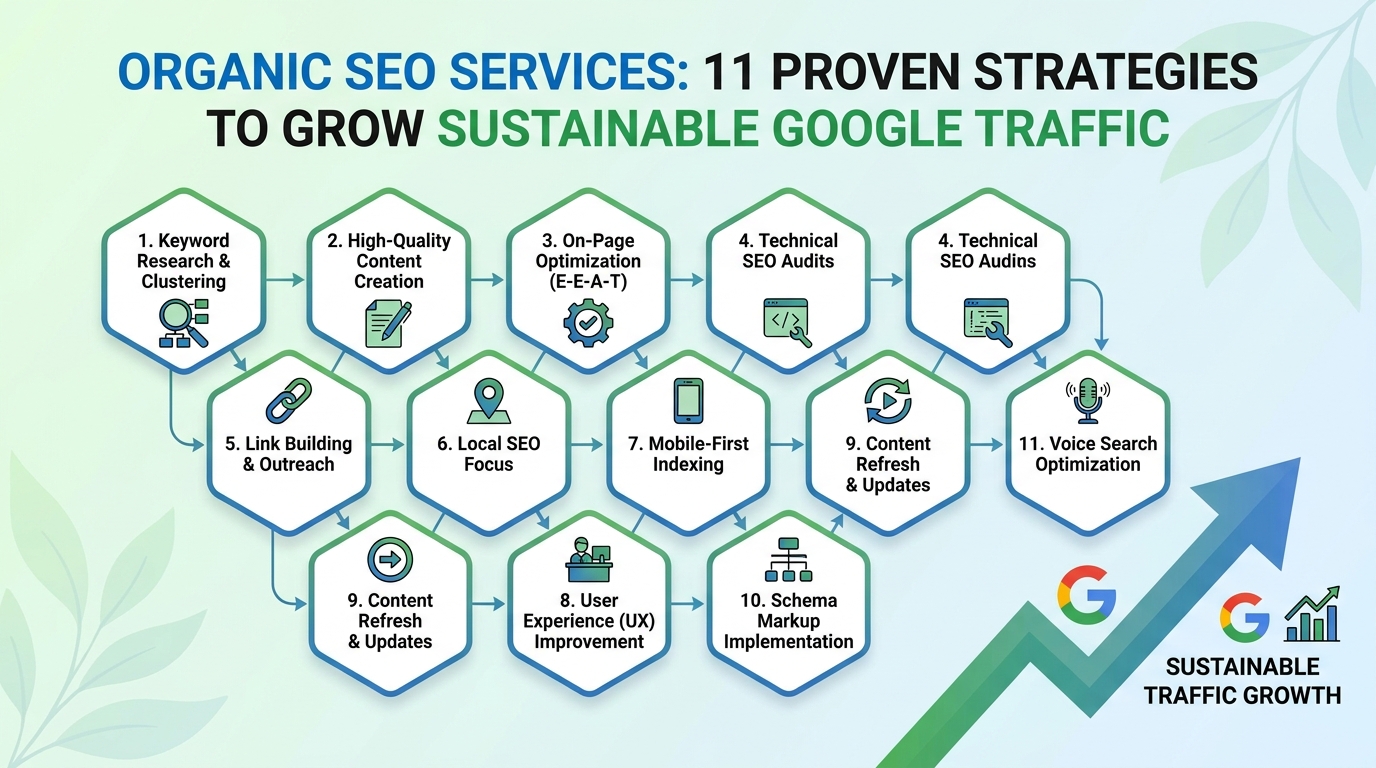
11 Practical Strategies for Better Organic Growth
Businesses looking to improve search visibility can focus on several principles.
Start with search intent. Build pages around what users actually want to accomplish.
Fix technical barriers. Make important content accessible, indexable, and easy to navigate.
Create genuinely useful content. Answer questions better than competing resources.
Demonstrate first-hand experience. Include original examples, data, screenshots, processes, opinions, and case studies where appropriate.
Build topic clusters. Connect related pages so users and search engines can understand the broader subject.
Improve internal linking. Guide visitors toward useful next steps while strengthening relationships between relevant pages.
Earn authoritative mentions. Create assets worth referencing instead of buying questionable links.
Optimize for conversions. Ranking is valuable only when visitors can become leads or customers.
Refresh important content. Update pages when information, products, regulations, or user expectations change.
Monitor competitors. Identify where competitors are outperforming you and determine whether the gap is content, authority, UX, technical SEO, or intent.
Measure business outcomes. Track qualified leads, sales, revenue, and customer acquisition—not rankings alone.
These principles form the foundation of sustainable organic SEO services.
Common SEO Mistakes to Avoid
One common mistake is keyword stuffing.
Repeating a phrase dozens of times can make content unnatural and may distract from the user’s actual needs.
Another mistake is publishing content simply because a keyword has search volume.
Google’s current guidance specifically warns against creating content primarily to attract search-engine traffic and emphasizes original, comprehensive, people-first information.
Other mistakes include buying low-quality links, creating hundreds of near-identical location pages, ignoring technical problems, copying competitor content, chasing every trending topic, and measuring success exclusively through rankings.
Another major mistake is expecting SEO to be a one-time project.
Search results change. Competitors improve. Customers change the questions they ask. Products evolve. Websites are redesigned. New content enters the market.
A successful SEO program therefore needs continuous monitoring and refinement.
Are Organic SEO Services Worth It?
For businesses that depend on online discovery, the answer can be yes—provided the strategy is aligned with realistic goals.
The value of organic SEO services is not simply higher rankings.
The real value can come from building an acquisition channel that consistently connects your company with people actively searching for your products, services, expertise, or solutions.
A strong organic presence can also strengthen brand credibility. When users repeatedly encounter your company while researching important questions, your brand can become associated with the topic itself.
However, SEO should not operate in isolation.
It works best when connected to strong branding, conversion optimization, content marketing, product quality, customer experience, analytics, and broader digital marketing.
Frequently Asked Questions
What are organic SEO services?
Organic SEO services are professional activities designed to improve unpaid search visibility. They commonly include keyword research, technical SEO, content optimization, on-page SEO, internal linking, authority building, local SEO, analytics, and ongoing strategy.
How are organic SEO services different from PPC?
PPC involves paying for advertising placements, while organic SEO services focus on earning visibility in unpaid search results. PPC can provide immediate exposure, whereas SEO generally requires longer-term investment and continuous optimization.
How long does organic SEO take to show results?
There is no universal timeline. Some technical improvements can affect search visibility quickly, while content and authority-building efforts may take months. Google notes that some changes can take days to show effects, while broader improvements may require several months.
Can SEO guarantee a number-one Google ranking?
No reputable provider can guarantee a specific Google ranking. Search results are dynamic, competitors change, and Google’s systems continuously evolve. Google itself states that following best practices does not guarantee a page will appear in its results.
Are organic SEO services useful for small businesses?
Yes. Local businesses can use organic SEO services to target valuable geographic and service-related searches, build useful location content, strengthen their online presence, and attract customers actively looking for their services.
What should I look for in an SEO company?
Look for experience, transparent reporting, clear strategy, ethical optimization methods, strong content expertise, technical knowledge, and an emphasis on qualified traffic and conversions rather than rankings alone.
Final Thoughts
Organic SEO services are not a shortcut to instant rankings. They are a long-term investment in your website’s visibility, usefulness, authority, and ability to attract qualified customers from search engines.
The strongest strategy combines technical SEO, search-intent research, high-quality content, internal linking, authoritative mentions, local optimization, conversion improvement, and continuous measurement.
Most importantly, modern SEO should begin with the audience—not the algorithm. Google’s current guidance consistently emphasizes helpful, reliable, people-first content, and its Search Essentials highlight technical accessibility, relevant language, and strong content practices.
If your website already has valuable products, services, or expertise but is struggling to gain search visibility, a carefully planned SEO audit can be a practical first step. From there, the right organic SEO services strategy can turn search demand into a sustainable source of qualified traffic, leads, and revenue.





One Comment